
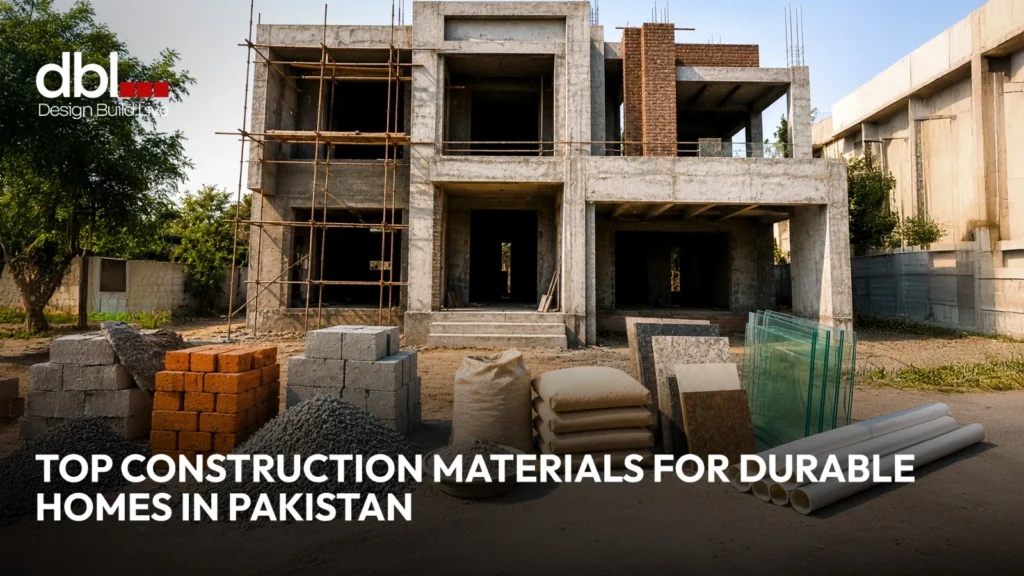
Choosing the best construction materials in Pakistan is the single biggest decision that determines how long your building will last. Pakistan’s construction market is flooded with options — and just as often, with substitutions. Substandard cement, re-rolled steel, and unwashed sand end up in more Pakistani builds than most owners realise, and the damage only shows up years later as cracks, dampness, or structural failure.
This guide covers the best building materials in Pakistan for any serious project — whether you’re constructing a 5 Marla home in Islamabad, a commercial plaza in Rawalpindi, or an overseas investment property. We’ll compare the top brands, list the exact specifications to insist on, and show you how to verify quality on-site.
Quick Summary: Best Construction Material Brands in Pakistan (2026)
| Material | Top Brands in Pakistan | Key Spec to Demand |
| Cement | Lucky, Bestway, DG Cement, Maple Leaf, Fauji, Cherat | OPC 53 Grade, PSQCA-certified, under 90 days old |
| Steel rebar | Amreli, Mughal, Agha Steel, Ittefaq | Grade 60 (420 MPa), Mill Test Report |
| Bricks | First-class kiln-fired | Min. 105 kg/cm² compressive strength |
| Tiles | Master Tiles, Shabbir Tiles, Stile | Porcelain, <0.5% water absorption |
| PPRC pipes | Popular, Master, Adamjee, Dadex | PN-20 rated |
| Paint (exterior) | ICI Dulux Weathershield, Berger WeatherCoat | Weather-shield emulsion |
1. Which Cement is Best in Pakistan?
Cement is the most-substituted material on Pakistani job sites, though fraud usually happens through ratio manipulation rather than brand swapping.
Top cement brands in Pakistan include Lucky Cement, Bestway, DG Cement, Maple Leaf, Fauji, and Cherat. All are PSQCA-certified and meet ASTM C150 standards. Rather than picking a “premium” name, choose based on local availability and batch freshness — a fresh bag from any of these outperforms an aged bag from a bigger brand. Reject any cement older than 90 days from manufacture.
The Three Types of Cement and Where to Use Each
- Ordinary Portland Cement (OPC 53 Grade) — the workhorse for slabs, columns, beams, and most superstructure work.
- Sulphate Resistant Cement (SRC) — mandatory for foundations in saline or aggressive soils, common in parts of Punjab and coastal Sindh.
- White cement — architectural, used for finishes and decorative pointing.
The most common contractor mistake is a watered-down water-cement ratio. The correct ratio is 0.45–0.50 for structural work. Anything higher saves the contractor time and curing water — but kills concrete strength.
2. Best Steel for Construction in Pakistan
For any load-bearing element, Grade 60 deformed bars (420 MPa yield strength) are the Pakistani standard, conforming to ASTM A615 or PSQCA specifications.
Top steel brands in Pakistan are Amreli Steel, Mughal Steel, Agha Steel, and Ittefaq. Each carries certificates of conformity for every lot. Always insist on the Mill Test Report (MTR) with every delivery.
Three Checks Before Any Bar Goes Into the Formwork
- Rib pattern — Grade 60 rebar has a clear, uniform deformation pattern. Smooth, irregular, or worn ribs indicate re-rolled scrap steel.
- Weight-per-metre — a 12 mm Grade 60 bar weighs approximately 0.888 kg/metre. Light bars mean under-rolled steel.
- Brand markings — genuine bars carry a rolled-in mill stamp at regular intervals.
3. Best Bricks in Pakistan
Pakistani brick quality varies dramatically between kilns. The classification matters more than most owners realise.
- First-class bricks are well-burnt, uniform red, free of cracks, and ring sharply when struck together. They’re the only acceptable choice for external walls, structural masonry, and load-bearing positions.
- Second-class bricks are softer and less uniform, acceptable only for internal partitions or filler work — never for structural load paths.
How to Test Brick Quality On-Site
- Water absorption must be 15–20% of the brick’s weight after 24 hours of immersion.
- Compressive strength must be a minimum of 105 kg/cm² (10.5 MPa) for first-class brick.
- Drop test — drop from waist height onto firm ground; a good brick should not shatter.
Second-class bricks are often smuggled into load-bearing walls and hidden under plaster. Once plastered, the only sign is premature dampness or cracking years later.
4. Best Sand and Aggregate for Construction in Pakistan
Sand quality affects concrete strength more than any other input — and it’s usually the first material compromised on tight budgets.
- Washed river sand (Lawrencepur, Ravi, or Chenab sand) is the correct choice for structural concrete. Its rounded grains produce a workable, dense mix.
- Crusher sand (stone dust) is suitable for masonry mortar and plaster, where its angular shape improves bond.
Substituting crusher sand into structural concrete reduces strength by 30–40%, and the substitution is nearly impossible to detect once the slab is poured.
For most reinforced work, 20 mm graded crushed stone aggregate is standard. Mass concrete and footings can use 40 mm. Always check sand for silt: a settling test in a glass jar should show no more than 4–6% silt content. Anything higher means the contractor is supplying unwashed material.
5. Best Waterproofing Materials in Pakistan
Islamabad’s monsoon rainfall and the broader Punjab heat-rain cycle make waterproofing non-negotiable.
Best waterproofing systems for roofs in Pakistan:
- Bituminous membrane (torch-applied) — the industry standard for flat roofs. Specify a 4 mm minimum thickness with proper overlap at all seams.
- Liquid-applied polyurethane coatings — excellent for complex roof geometries, parapet junctions, and refurbishments.
- Crystalline waterproofing admixtures — mixed directly into the concrete, ideal where membranes are impractical.
Islamabad’s clay-and-rock subsoil concentrates monsoon runoff against basement walls. The correct approach is a combined system: crystalline admixture in the concrete itself, plus an external bituminous or HDPE membrane. Cementitious slurry coatings alone are not sufficient below grade.
6. Best PPRC Pipes for Water Supply in Pakistan
Galvanised iron rusts. Copper is expensive and corrodes in Pakistan’s hard water. PPRC (Polypropylene Random Copolymer) has replaced both.
PPRC pipes offer a 50-year design life under standard pressure and temperature, don’t rust or scale internally, and use heat-fusion joints that effectively make the system a single continuous pipe with no weak fittings to fail.
What to specify when ordering PPRC pipe: insist on PN-20-rated pipe for hot and cold supply lines, from established manufacturers, like Popular, Master, Adamjee, or Dadex.
7. Best Finishing Materials in Pakistan
Finishes are what the client sees and touches daily. Specifying them properly protects both appearance and lifespan.
Tiles
For Pakistani homes, porcelain tiles (water absorption under 0.5%) are essential for bathrooms, kitchens, terraces, and high-traffic areas. Ceramic tiles (3–10% absorption) are acceptable for bedrooms and lounges with lighter use.
Top tile brands in Pakistan — Master Tiles, Shabbir Tiles, and Stile — produce reliable porcelain ranges with consistent calibration.
Paint
Keep Pakistan’s climate in mind. Use weather-shield exterior emulsion (ICI Dulux Weathershield, Berger WeatherCoat, or equivalent) for all external surfaces. For internal walls, use silk or matt emulsion over a properly applied alkali-resistant primer.
Bathrooms need an anti-fungal emulsion to resist humidity. Two-coat primer systems are the minimum requirement.
Construction Material Prices in Pakistan (July 2026)
Material costs are one part of the picture.
Note: prices vary weekly by region. Below is a general reference range for Twin Cities.
| Material | Approximate Price Range (PKR) |
| Cement (50 kg bag) | 1,385 – 1,570 per 50kg bag |
| Steel bar Grade 40/60 (per kg) | 258 – 265 per kg |
| First-class brick (per piece) | 18 – 22 per unit |
| Washed sand (per cft) | 75 – 138 per cft |
| Crushed aggregate (per cft) | 120 – 310 per cft |
For the full breakdown of commercial construction costs in Pakistan, see our cost-reduction guide!
Where to Buy Quality Building Materials in Pakistan
Reliable sourcing matters as much as brand choice. For major projects, buy directly from mill-authorised dealers rather than open-market suppliers. This protects you from re-rolled steel, aged cement, and second-class bricks being invoiced as first-class.
DBL maintains an approved supplier network across Islamabad, Rawalpindi, and Lahore, with verification at the point of delivery.
How DBL Specifies and Verifies Materials on Every Project
At DBL, material quality isn’t left to the contractor’s discretion. Every project begins with a detailed Bill of Quantities (BOQ) with approved brands, grades, and specifications for each material — from cement strength class to PPRC pressure rating.
We maintain an approved supplier list, conduct on-site verification of every major delivery, and document each step. That verification process is the difference between a building that lasts three decades and one that lasts a lifetime. It’s also the reason clients — including overseas Pakistanis who can’t supervise their build in person — trust DBL with their most important projects.
Talk to DBL about your construction material specifications.
Frequently Asked Questions
What are the best construction materials in Pakistan for durability?
Grade 60 steel rebar, OPC 53-grade cement, first-class kiln-fired bricks, washed river sand, and PN-20 PPRC pipes form the core of a durable Pakistani build. Substituting any of these is the leading cause of premature failure.
Which steel brand is best for construction in Pakistan?
Amreli Steel, Mughal Steel, Agha Steel, and Ittefaq are Pakistan’s top mills. Always demand the Mill Test Report and verify rib pattern, weight-per-metre, and brand markings on delivery.
How do I check brick quality on-site?
First-class bricks ring sharply when struck, absorb 15–20% water in 24 hours, resist a waist-height drop test without shattering, and have a compressive strength of at least 105 kg/cm².
Who are the best building material suppliers in Pakistan?
Buy directly from mill-authorised dealers of the brands listed above. DBL maintains a verified supplier network in Islamabad, Rawalpindi, and Lahore for our clients’ projects.
What is the correct water-cement ratio for structural concrete?
0.45 to 0.50. Higher ratios reduce concrete strength significantly and are a common contractor shortcut.