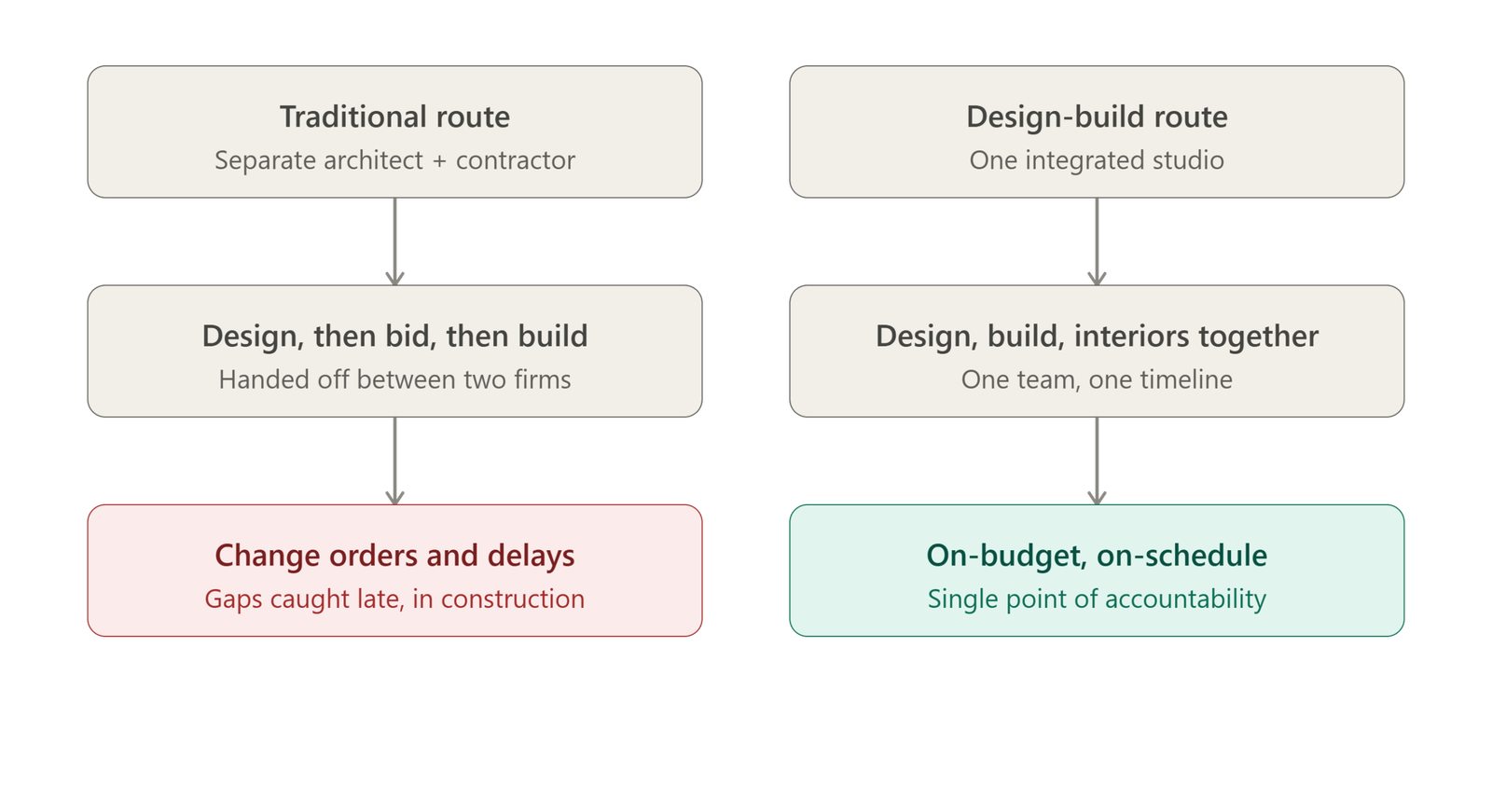


If you’ve ever renovated or built anything, you’ve probably heard the classic advice: hire an architect first, get your drawings finished, then go find a contractor to bid the job. It sounds sensible. In practice, it’s often where projects start to go sideways.
The traditional route has a structural problem. The architect who designs your space and the contractor who builds it aren’t on the same team. They’re not even in the same room until the design is “done” — at which point the contractor sees it for the first time, prices it, and inevitably finds things that cost more, take longer, or don’t quite work in the real world. Every one of those discoveries becomes a change order. Every change order means a phone call between two firms who didn’t talk to each other during design, a delay while they sort out who’s responsible, and a line item added to your budget.
Design-build closes that gap by putting the whole team under one roof. At a studio like Design Build Live, the architects, the construction team, and the interior designers work from the same set of drawings from day one — not handed off in sequence, but collaborating in parallel. A detail that looks great on paper but is expensive to build gets caught in week two, not month six. Material and finish decisions get made with the interior design team, not bolted on afterward, so your kitchen island isn’t sized around a cabinet order nobody flagged until installation day.
What that actually changes for you
One point of accountability. When something needs adjusting, there’s no finger-pointing between “the architect’s plan” and “the contractor’s execution.” One team owns the outcome, start to finish.
A realistic budget from the start. Because the people pricing the work are involved while it’s still being designed, cost estimates reflect what things actually cost to build — not a guess made before construction ever entered the conversation.
Faster timelines. Design and pre-construction can overlap instead of running strictly in sequence, since the builders aren’t waiting for a finished, siloed drawing set to begin figuring out logistics.
Interiors that belong to the architecture, not an afterthought. When interior design is part of the same studio, finishes, lighting, and built-ins are considered alongside structural and spatial decisions — not squeezed in once the walls are already up.
Fewer surprises, fewer change orders. Most change orders exist because two disconnected teams didn’t catch a conflict early. An integrated team catches it earlier, because they’re the same people from concept through completion.
Is design-build right for every project?
Not automatically — a highly specialized or unusually large commercial build may still call for competitive bidding among multiple contractors, and some clients specifically want that separation of roles for checks and balances. But for most residential renovations, new builds, and small-to-midsize commercial fit-outs, the coordination overhead of the traditional model rarely pays for itself. You’re not getting more oversight by splitting design and construction — you’re mostly getting more handoffs.
The bottom line
Hiring separately isn’t wrong, but it asks you to be the project manager stitching two firms together. Design-build asks one studio to own that job instead — so you spend less time managing your project and more time watching it come together the way you pictured it.